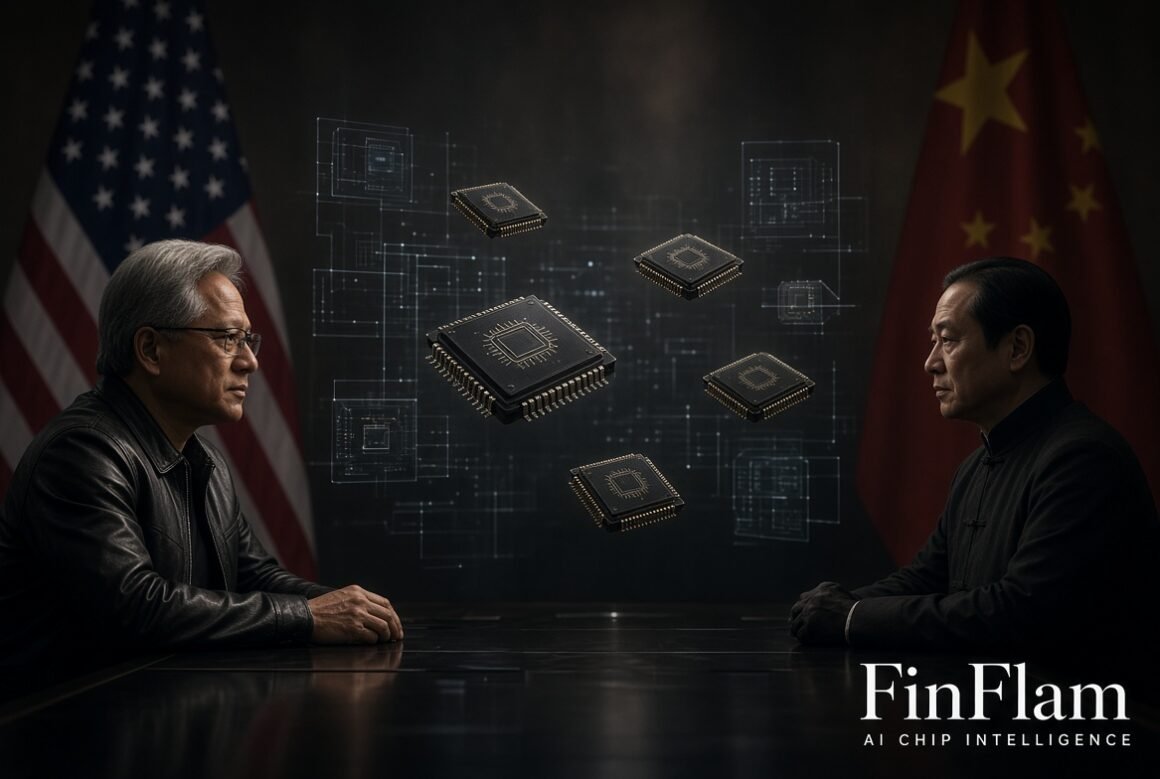
How the Nvidia “Honeypot” Scandal Should Backfire on China
China’s Ministry of State Security ran a classic honeytrap on Jensen Huang, the man who built Nvidia into the indispensable engine of the artificial intelligence race. U.S. intelligence concluded that Alice Huang (also known as Huang Le), a Chinese national tied to the Singapore-based firm Megaspeed, cultivated a personal relationship with Huang while Megaspeed was moving large volumes of advanced Nvidia chips. Reports indicate those chips, including restricted H100 and H200 models, reached Chinese entities in the billions of dollars. Huang later admitted the affair, apologized to employees, and stepped down as CEO amid the fallout and additional personal revelations. Nvidia’s board has opened an investigation and stated it currently has no reason to believe core secrets or national security were compromised. The FBI is examining whether Huang was targeted. President Trump was briefed more than once.
This is not a private morality play. It is industrial-scale espionage aimed at the single most important commercial and military technology of the decade. China’s spy chief Chen Yixin has publicly stated that whoever masters AI “grasps the pulse of the times” and that advances threaten the Chinese Communist Party’s political and ideological security. Beijing treats American chip design, process technology, and customer data as strategic assets to be stolen or diverted, not goods to be purchased under the rules. The honeytrap fits a documented pattern: influence operations, illicit chip diversion through third countries, and the recruitment of assets around critical companies. Megaspeed itself had faced prior U.S. scrutiny over chip accounting gaps measured in the tens of thousands of units.
The scandal should accelerate, not soften, American restrictions. Every advanced GPU that reaches Chinese military or state AI programs shortens the timeline on which Beijing can field autonomous weapons, surveillance systems, and cyber tools aimed at the United States. Huang and others in Silicon Valley spent years arguing that open sales to China were necessary for American companies and that Beijing would simply develop its own chips if denied. The evidence shows the opposite: when access is restricted, China steals, diverts, or runs intelligence operations to regain it. Allowing continued high-volume sales under the theory of commercial engagement simply funds the opponent’s research and development while exposing American executives and supply chains to exactly this kind of targeting.
National security is not a free-market footnote. A sovereign country can and should limit the export of dual-use technologies that give a strategic adversary an asymmetric advantage. That principle is older than the Cold War and applies equally to semiconductors, rare earth processing, or advanced manufacturing tools. Corporate boards that treat Chinese access as an ordinary commercial relationship are ignoring the documented behavior of the Ministry of State Security. Shareholders should demand full transparency on any chip flows linked to Megaspeed or similar intermediaries. Lawmakers should tighten end-use monitoring, expand entity list designations, and treat diversion as a national-security offense rather than a regulatory footnote.
China will deny the allegations, as it always does, and claim the story is a smear designed to justify restrictions. The pattern of Chinese technology acquisition—cyber theft, talent recruitment, front companies, and now personal compromise of a CEO—is too consistent and too long-running to be dismissed as media invention. The proper response is not to lecture Beijing on fair play. It is to assume the worst, close the loopholes, and stop transferring the tools of American technological superiority into the hands of a regime that has stated its intention to overtake and, where necessary, confront the United States.
The honeypot worked on one man. It does not have to work on American policy. Tighter controls, rigorous enforcement, and an end to the pretense that commercial sales to China are neutral will make the next attempt more expensive and less effective. That is the only outcome that matches the scale of the threats.

Big John
I have an Associates & Bachelors Degree in Criminology with a minor in Political Science. I've been blogging since around 2017, my work has been viewed by 800,000 people, and I am a registered Libertarian. My work has been talked about on many of the largest news outlets in the world from Reuters, USA Today, Politifact, CheckYourFact.com, The Quint and many other outlets.


You May Also Like

Alyssa Milano Rips Jon Voight for supporting Trump & Goes off on Twitter

Joe Flacco Proved Yesterday Why Alex Smith Is the Ultimate Pro Quarterback
