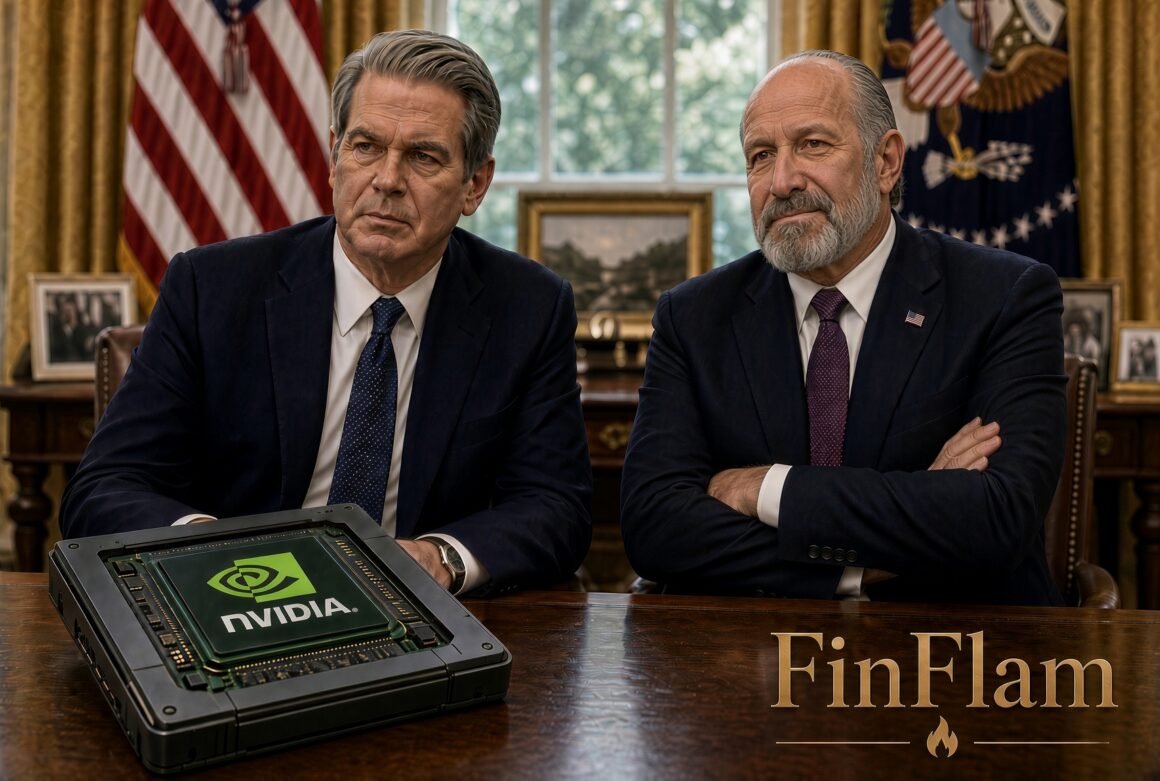
The War of Money in the White House; Bessent Is Right. Lutnick’s Delays Are the Problem.
Treasury Secretary Scott Bessent went on CNBC and said the quiet part out loud: multiple agencies—Treasury, Defense, State, and the U.S. Trade Representative—had been pushing for months to put Megaspeed on the Entity List, the tool that would have restricted advanced Nvidia chip exports to a company tied to the alleged Chinese intelligence asset at the center of the Jensen Huang scandal. Commerce, led by Howard Lutnick, held the pen and did not move. Bessent called the leakage of chips above the H100 level “very frustrating” because it gives China an edge in the AI race, directly contradicting President Trump’s stated position that China should not receive those chips.
That is the factual core. Reporting from Axios, CNN, and others describes a Situation Room confrontation in which Bessent challenged Lutnick on the delay. Other senior officials sided with the tighter-control side. Trump himself had authorized action against suspected diversion on at least three occasions earlier in the year. Commerce’s Bureau of Industry and Security is the agency that actually writes the list. When the agency that controls the pen slow-walks a restriction that the rest of the national-security apparatus and the President have already signaled, the result is exactly what happened: billions in advanced chips moving through intermediaries while a honeytrap operated around the CEO of the company that designed them.
Bessent’s record on this file is clearer. He has consistently treated advanced semiconductors as strategic assets rather than ordinary commercial goods. He has pushed for enforcement that matches the scale of Chinese diversion and intelligence activity. Lutnick’s Commerce Department has the statutory tools and the institutional knowledge. The public record shows repeated resistance or delay on Megaspeed specifically, even as intelligence concerns were circulating and Trump had been briefed. Personal relationships between Lutnick and Huang have been noted in reporting; whether that influenced the pace is for the ongoing inquiries and any congressional testimony to examine. The operational outcome is not in dispute: the Entity List action did not happen on the timeline the rest of the administration wanted.
Who has been right more often? On the narrow but decisive question of stopping leakage of restricted AI chips into China, Bessent’s side has been aligned with the intelligence warnings, the President’s public red lines, and the interests of every American company that competes with state-backed Chinese AI efforts. Lutnick’s department has not executed those restrictions. That is a measurable failure of process, not a difference of legitimate commercial philosophy. Free trade does not require shipping the means of military and surveillance advantage to a regime that openly runs intelligence operations against American executives.
Public trust is harder to quantify in real time, but the distinction is straightforward. Americans who prioritize national security and the AI race see delayed enforcement as the problem. Those who prioritize uninterrupted commercial flows to China see tighter controls as the risk. Polling on these specific officials is thin, but the broader public has shown consistent support for limiting advanced technology transfers to China when the alternative is documented diversion and espionage. Trump’s trust is personal and longstanding with Lutnick—decades of acquaintance, including after the September 11 losses at Cantor Fitzgerald. That relationship has protected Lutnick through earlier disputes. It does not change the operational record on chip controls. Reports have circulated of internal discussions about whether Lutnick remains the right person to run Commerce; the White House has publicly stood by him. The odds of an immediate ouster are low precisely because of that personal bond. The odds that Commerce will now face sustained congressional and inter-agency pressure to close the loopholes are high.
The outcome that serves the country is simple: Megaspeed and similar intermediaries go on the Entity List, end-use monitoring tightens, and the next attempt to route restricted chips through third countries becomes harder and more expensive for Beijing. Bessent has been pushing in that direction. Lutnick’s department has the authority and has not used it on the timeline the rest of the government requested. That is the record. National security is not a favor to a trading partner or a personal acquaintance. It is the baseline requirement before commercial considerations.

Big John
I have an Associates & Bachelors Degree in Criminology with a minor in Political Science. I've been blogging since around 2017, my work has been viewed by 800,000 people, and I am a registered Libertarian. My work has been talked about on many of the largest news outlets in the world from Reuters, USA Today, Politifact, CheckYourFact.com, The Quint and many other outlets.

You May Also Like

San Francisco Declares the NRA a Terrorist Organization

Princess Diana Statue to be Installed at Kensington Palace for her 60th Birthday
