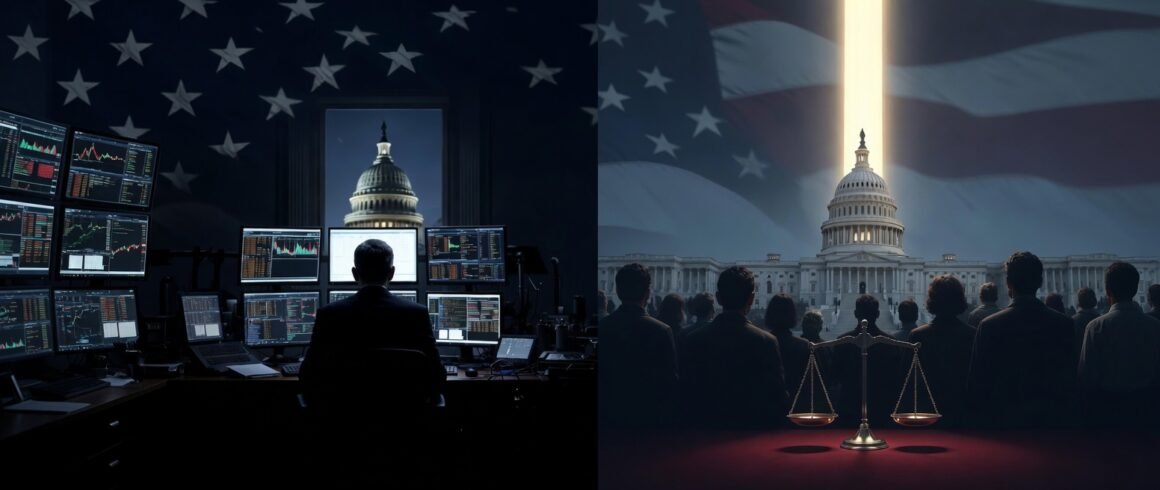
Detailed Examination of the Stop Insider Trading Act (H.R. 7008)
Overview
The Stop Insider Trading Act (H.R. 7008) was introduced on January 12, 2026, by Rep. Bryan Steil (R-WI), Chairman of the House Administration Committee. It amends the Ethics in Government Act to place new restrictions on stock transactions by members of Congress and their immediate families. The bill has advanced through committee and has been under active consideration in the House.
It is not a full ban on stock ownership or trading. It is a targeted restriction focused on new purchases and transparency around sales.
Key Provisions
1. Who Is Covered
- Members of Congress (House and Senate)
- Their spouses
- Their dependent children
These are defined as “covered individuals.”
2. What Is Restricted (“Covered Investments”)
- Securities issued by publicly traded companies
- Comparable economic interests (including certain derivatives in some interpretations)
Exemptions (what is still allowed):
- Diversified mutual funds and ETFs
- Certain small business investments
- Trusts where the member has no control or knowledge of specific holdings
- Reinvestment of dividends in some cases
- Employment compensation received by spouses or dependent children (per manager’s amendment)
3. The Core Rules
- Ban on new purchases: Covered individuals may not buy covered investments while the member is serving in Congress.
- Advance notice for sales: Before selling any covered investment, the member must file a public notice of intent to sell. The notice must be filed between 7 and 14 days before the sale. The Clerk of the House or Secretary of the Senate must publish it online. If the sale does not occur, the notice must be withdrawn.
- Existing holdings can be kept. Members are not forced to divest stocks they already own.
4. Penalties for Violations
- Civil fee of the greater of $2,000 or 10% of the value of the transaction
- Plus any net gain realized from the transaction
- For illegal purchases, the individual may be required to sell the investment
What the Bill Does Not Do
- It does not force members to sell stocks they already own.
- It does not ban ownership of individual stocks.
- It does not currently extend the same rules to the President, Vice President, Cabinet, or judiciary (though amendments to expand it have been proposed and debated).
- It does not fully close every possible loophole (critics point to potential issues with cryptocurrencies, commodities, or private company interests in some analyses).
Current Status (as of late July 2026)
The bill was reported by the House Administration Committee and has moved through the Rules Committee. It has been paired in some procedural contexts with other measures (including voter ID provisions in certain packages). Floor action has been imminent or underway depending on the exact legislative calendar.
Why It Was Written This Way
Supporters (led by Steil and Senate counterparts such as Sens. Cassidy and Ricketts) designed it as a pragmatic compromise. A pure, immediate forced-divestiture ban has repeatedly failed in past Congresses because many members resist liquidating long-held assets or worry about deterring private-sector talent from running for office. This version stops the most problematic activity (new individual stock purchases that could be timed to legislation) while adding real-time transparency on sales.
Criticisms
- Progressive and good-government groups (e.g., Campaign Legal Center) argue it is too weak because members can still own and sell stocks, and the appearance of conflicts remains.
- Some conservatives and libertarians want stronger or broader coverage (including the executive branch).
- Others note that advance notice of sales could itself move markets or create new issues.
Bottom Line
H.R. 7008 is a limited but concrete restriction: no new individual stock purchases by members or their immediate families, mandatory public notice before sales, and higher penalties. It is the furthest a stock-trading restriction bill has advanced in recent years. Whether it becomes law depends on Senate action and final negotiations.
Would you like me to expand on any specific section (penalties, exemptions, comparison to stronger alternative bills, or political outlook)?

Big John
I have an Associates & Bachelors Degree in Criminology with a minor in Political Science. I've been blogging since around 2017, my work has been viewed by 800,000 people, and I am a registered Libertarian. My work has been talked about on many of the largest news outlets in the world from Reuters, USA Today, Politifact, CheckYourFact.com, The Quint and many other outlets.


You May Also Like
Truth Social: Trump’s Reaction to Biden’s Presidential State of the Union Address

Breaking News: Robert Mueller to testify in front of Congress