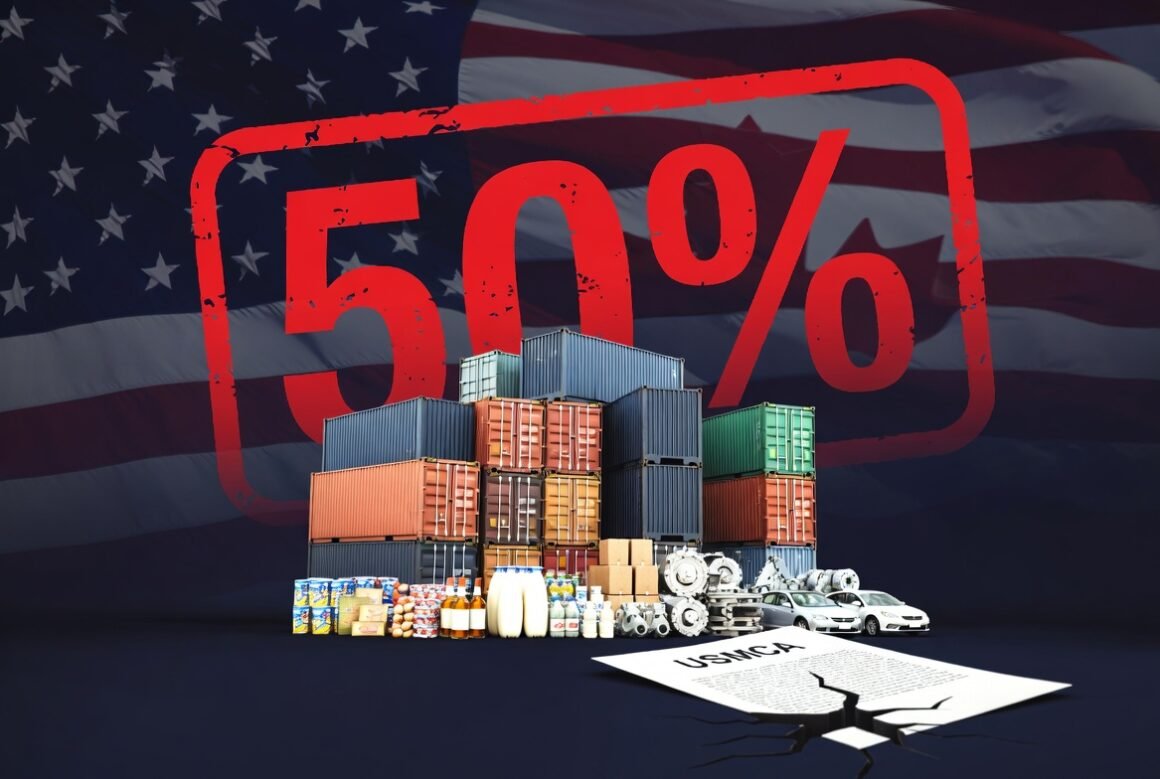
Trump Hits Canada with 50% Tariffs: Standing Up to Discrimination Against American Workers
On July 20, 2026, President Donald Trump signed three presidential proclamations imposing an additional 50% tariff on a wide range of Canadian goods. The move targets roughly $20 billion in Canadian imports and is scheduled to take effect on August 19, 2026.
This is not a random trade spat. It is a direct response to what the White House calls Canada’s long-standing discrimination against key American exports — specifically motor vehicles, alcoholic beverages, and dairy products.
What Exactly Happened
Trump invoked Section 338 of the Tariff Act of 1930, a rarely used provision that allows the President to impose duties of up to 50% when a foreign country discriminates against U.S. commerce. This is the first time in decades a president has used this authority.
Three separate proclamations were issued:
- One addressing discrimination against U.S. motor vehicles
- One addressing discrimination against U.S. alcoholic beverages
- One addressing discrimination against U.S. dairy products
The tariffs apply to a broad list of Canadian products, ranging from wine, beer, spirits, and dairy items to hockey sticks, cement, and hundreds of other goods listed in the annexes. Critically, these duties apply even to goods that would otherwise qualify for preferential treatment under the U.S.-Mexico-Canada Agreement (USMCA).
Why Trump Did It
The administration argues that Canada has systematically disadvantaged American producers:
- Canadian provinces pulled many U.S. alcohol products from liquor store shelves.
- Canada maintained tariffs and quotas that limited U.S. vehicle exports.
- Canada restricted U.S. dairy access while giving preferential treatment to other trading partners, particularly the European Union.
U.S. officials point to sharp drops in American exports — including an 81% decline in alcohol exports and a 22% drop in vehicles in certain categories — as evidence of the harm.
In short, Canada was protecting its own industries while limiting American access to its market. Trump’s response is reciprocal pressure: if Canada discriminates against U.S. goods, the United States will raise the cost of Canadian goods entering our market.
The Economic Stakes
These tariffs will hit Canadian exporters hard. They will also raise costs for some U.S. importers and consumers of the affected products. That is the nature of tariffs — they create leverage by imposing pain on the other side.
Supporters of the move argue this is exactly how trade negotiations should work. For years, American workers and farmers watched Canada maintain barriers while preaching free trade under USMCA. Reciprocal tariffs force the conversation back to fairness.
Critics claim the move risks a broader trade war with a close ally and undermines the USMCA. Canadian Prime Minister Mark Carney has called the tariffs a violation of the agreement and offered talks. Whether those talks produce real concessions for American producers remains to be seen.
The America First View
From a straightforward perspective, this action is consistent with the principle that trade must be fair, not one-sided. American dairy farmers, auto workers, and alcohol producers should not be expected to compete with a tilted playing field.
Section 338 gives the President a tool designed precisely for situations like this. Using it sends a clear message: the United States will no longer accept permanent disadvantages in the name of “partnership.”
The 30-day delay before the tariffs take effect also leaves room for negotiation. If Canada is serious about removing its discriminatory measures, there is time to reach a deal. If not, the higher duties will stand.
Bottom Line
President Trump’s 50% tariffs on Canadian goods are a deliberate, targeted response to documented discrimination against American exports in dairy, alcohol, and vehicles. They cover about $20 billion in trade and take effect in mid-August unless negotiations change the outcome.
Whether one views this as tough diplomacy or unnecessary escalation depends on whether fairness in trade is treated as a real priority or just a talking point. For American workers and producers who have faced restricted access to the Canadian market, the message is clear: the era of one-way concessions is over.

Big John
I have an Associates & Bachelors Degree in Criminology with a minor in Political Science. I've been blogging since around 2017, my work has been viewed by 800,000 people, and I am a registered Libertarian. My work has been talked about on many of the largest news outlets in the world from Reuters, USA Today, Politifact, CheckYourFact.com, The Quint and many other outlets.




[…] The Stop Insider Trading Act (H.R. 7008) was introduced on January 12, 2026, by Rep. Bryan Steil (R-WI), Chairman of the House Administration Committee. It amends the Ethics in Government Act to place new restrictions on stock transactions by members of Congress and their immediate families. The bill has advanced through committee and has been under active consideration in the House. […]