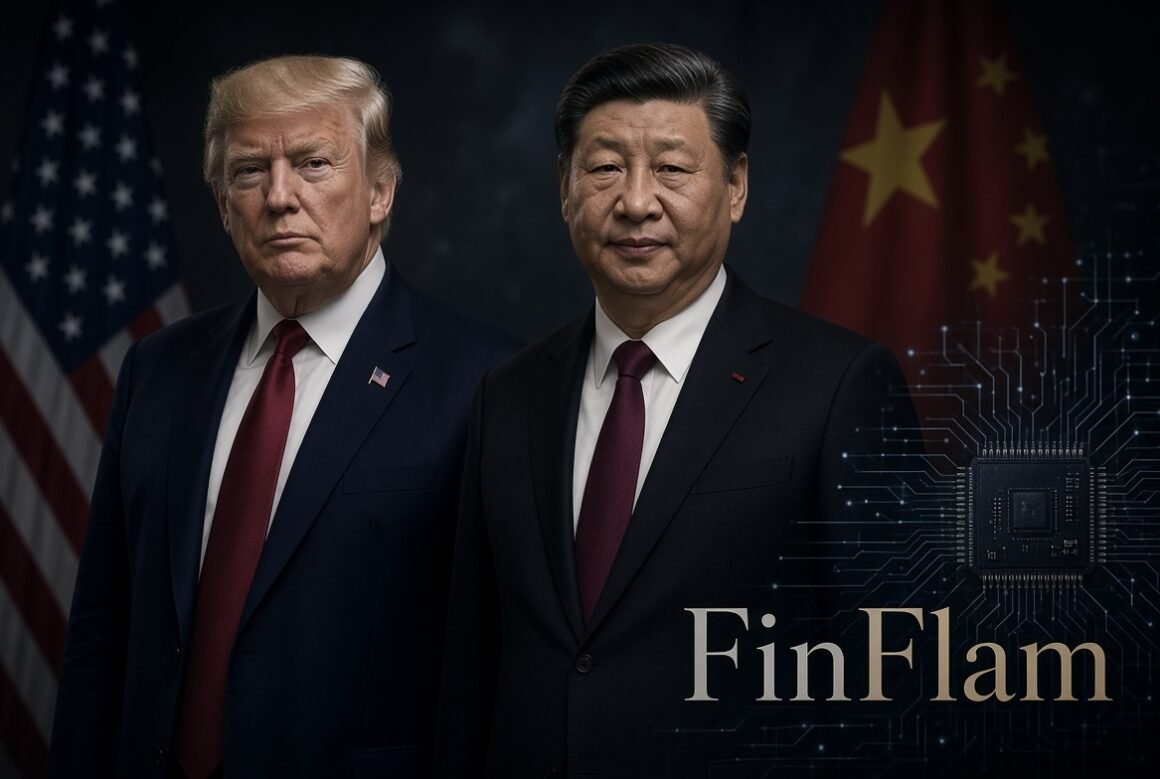
Trump Not Expected to Raise Nvidia Chinese Spy Allegations With Xi
Administration officials say President Trump is not expected to bring up the Nvidia espionage controversy when he meets Chinese President Xi Jinping at the APEC summit in Shenzhen next week. The focus, they say, will stay on implementing the existing trade agreement. Export controls are not on the table. The Alice Huang matter is an ongoing U.S. investigation, and the White House does not plan to read the Chinese in on it during these talks.
That is the official line. It is also incomplete.
The facts are straightforward. Jensen Huang, until this week the CEO of Nvidia, had a relationship with Alice Huang (no relation), a former executive at Megaspeed, a Singapore cloud company that has been under scrutiny for moving advanced Nvidia chips into China in ways that raised export-control questions. U.S. intelligence concluded she was a Chinese intelligence asset. Reports indicate Secretary of State Marco Rubio briefed Trump on the relationship, including during the May trip to Beijing. Trump has said he spoke to Huang, that Huang claimed he had no idea she was a spy, and that he believes him. Huang has since stepped down as CEO. Nvidia’s board opened an investigation. The stock took a hit. China calls the whole thing a baseless smear.
This is not a minor personal scandal. Nvidia’s chips are the hardware backbone of the AI race. Controlling who gets the best of them is one of the few remaining levers the United States still has over China’s military and surveillance capabilities. If a senior executive was in a close relationship with someone U.S. intelligence assessed as working for Beijing’s Ministry of State Security, that is a national-security problem, not a tabloid story. Previous reporting suggested the administration had been briefed earlier and chose not to act, partly to avoid disrupting Nvidia or the broader trade truce.
The decision not to put it on the formal agenda with Xi is the predictable diplomatic calculation. Summit meetings with the Chinese leader are narrow. The trade deal implementation is the stated priority. Raising an active counterintelligence matter involving a major American company would turn a scheduled economic discussion into an immediate confrontation. Officials want to keep export controls off the negotiating table so they are not bargained away. That part is consistent with an America First position: do not trade away the tools that limit China’s access to the most advanced chips.
At the same time, leaving it completely unmentioned carries its own cost. Beijing has already rejected the allegations and will treat silence as either weakness or confirmation that the United States does not treat the issue as serious. Trump has publicly said he is sure Xi will ask him about it. He has also defended Huang as an honorable man who built a great American company. That defense is understandable as a personal judgment, but it does not erase the intelligence assessment or the pattern of Chinese efforts to penetrate the companies that control the AI stack.
Whether Trump actually stays silent once he is in the room is a different question. He has a record of raising issues that staff preferred to keep quiet when he decides the moment is right. The user who wrote this piece is not the only one who expects the topic will surface one way or another. If it does, the useful version is not a public lecture. It is a clear statement that the United States is investigating the matter, that chip export controls remain in place regardless of any personal relationship, and that further diversion of advanced chips will have consequences. Anything softer signals that access to Nvidia’s technology is still negotiable when the relationship is close enough.
The larger point is simple. The AI competition with China is not won by ignoring counterintelligence problems inside the companies that make the decisive hardware. Trade deals matter. Stable talks with Xi matter. Neither of those things is more important than knowing whether the leading U.S. chipmaker was exposed to a Chinese intelligence operation. Officials can keep the formal agenda clean. The investigation and the export controls still have to be enforced either way. That is the part that determines whether the policy is serious or merely convenient for the next meeting.

Big John
I have an Associates & Bachelors Degree in Criminology with a minor in Political Science. I've been blogging since around 2017, my work has been viewed by 800,000 people, and I am a registered Libertarian. My work has been talked about on many of the largest news outlets in the world from Reuters, USA Today, Politifact, CheckYourFact.com, The Quint and many other outlets.


You May Also Like

Judge Judy Endorses Michael Bloomberg on ‘The View’ Smart or Dumb Choice?

BREAKING NEWS: The Missouri Senate Passes Bill Banning abortions after 8 Weeks
