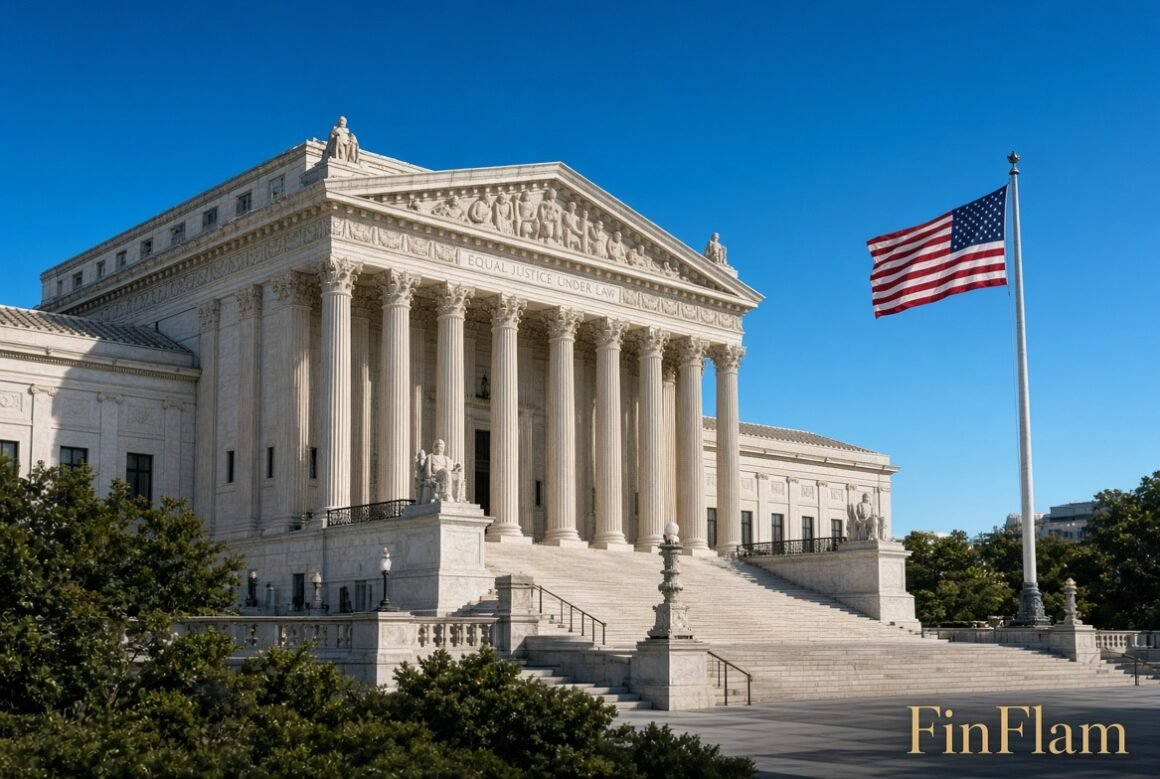
Supreme Court to Decide if Trump Can Bar Most Asylum Claims at the Southern Border
The Supreme Court agreed Friday to hear whether President Trump can continue barring most asylum claims at the southern border. The case is Mullin v. Refugee and Immigrant Center for Education and Legal Services. It tests the January 20, 2025 proclamation that declared an “invasion” and suspended entry for people crossing illegally or without required documents.
Lower courts said the president went too far. They ruled he cannot categorically shut off the asylum process Congress wrote into the Immigration and Nationality Act. The policy has stayed in effect while the government appealed. Arguments are expected next spring, with a decision by the end of June.
The administration says the policy is the single most important tool that collapsed border crossings. Official numbers show southwest border apprehensions in fiscal year 2026 dropped roughly 93–95 percent from Biden-era levels, to the lowest totals in agency history. Zero releases at the border for an entire fiscal year. Asylum grants collapsed. Cartel control over the crossing routes weakened. The White House argument is simple: when the system was flooded with millions of claims, many of them weak or fraudulent, the country lost the ability to enforce its border at all. Turning the faucet off restored order.
Opponents, led by the ACLU and immigrant-rights groups, say the proclamation invents an emergency that lets the executive ignore statutes. They argue asylum is a right that attaches the moment someone reaches the border, and that only Congress can rewrite the process. District Judge Randolph Moss and the D.C. Circuit agreed. They treated the proclamation as an attempt to replace the removal rules Congress set.
This is the core fight. One side says a president has the duty and the constitutional power to stop an uncontrolled influx that previous administrations treated as unmanageable. The other side says the statute is the statute, capacity does not matter, and judges will decide how many people the country must process. Earlier this year the Court already sided with the administration in a related “metering” case, holding that someone standing on the Mexican side of the border has not yet “arrived in the United States” for asylum purposes. That was a 6-3 win. This case is broader.
Most Americans have never been confused about the basic point. Large majorities have long supported a secure border and the removal of people who enter illegally. Support for deporting criminal illegal immigrants routinely clears 70–80 percent across party lines. Republicans and many independents who lived through the Biden-era surges credit Trump with ending the chaos they saw on the news every night. Working-class voters in border states and interior cities that absorbed the releases largely stand with the enforcement approach. They measure results by crossings, releases, and crime, not by process arguments.
The opposition is concentrated on the left and among advocacy organizations. Democrats and progressive groups treat any restriction on asylum processing as an attack on the idea that the United States must accept claims from anyone who reaches the border. Polls from groups such as Data for Progress show majorities saying the government should still allow asylum applications and should not deport people without a hearing. Those numbers track party lines more than geography. National security and capacity concerns that drove the policy do not move the same voters who prioritize open pathways.
The practical question the Court will answer is whether a president can actually close the border when Congress has written a process that cannot handle the volume, or whether lower-court judges can force the government to keep accepting claims that overwhelm the system. If the Court upholds the proclamation, the policy that produced the lowest crossing numbers in modern history stays. If it strikes the policy down, the legal tools that collapsed the numbers disappear and the pressure returns to whatever capacity the bureaucracy has on any given day.
A country that cannot control who enters cannot control its own future. The numbers under the current policy are the evidence. The Supreme Court will now decide whether those numbers were achieved by lawful authority or by an action that must be undone. The answer will matter long after this term ends.

Big John
I have an Associates & Bachelors Degree in Criminology with a minor in Political Science. I've been blogging since around 2017, my work has been viewed by 800,000 people, and I am a registered Libertarian. My work has been talked about on many of the largest news outlets in the world from Reuters, USA Today, Politifact, CheckYourFact.com, The Quint and many other outlets.


You May Also Like

Chris Cuomo Slammed by Critics After Criticizing Texas Leadership Amid Brothers Investigation

Testimony in Harvey Weinstein Trial Reveals He has ‘No Testicles’ & has a ‘Vagina’
