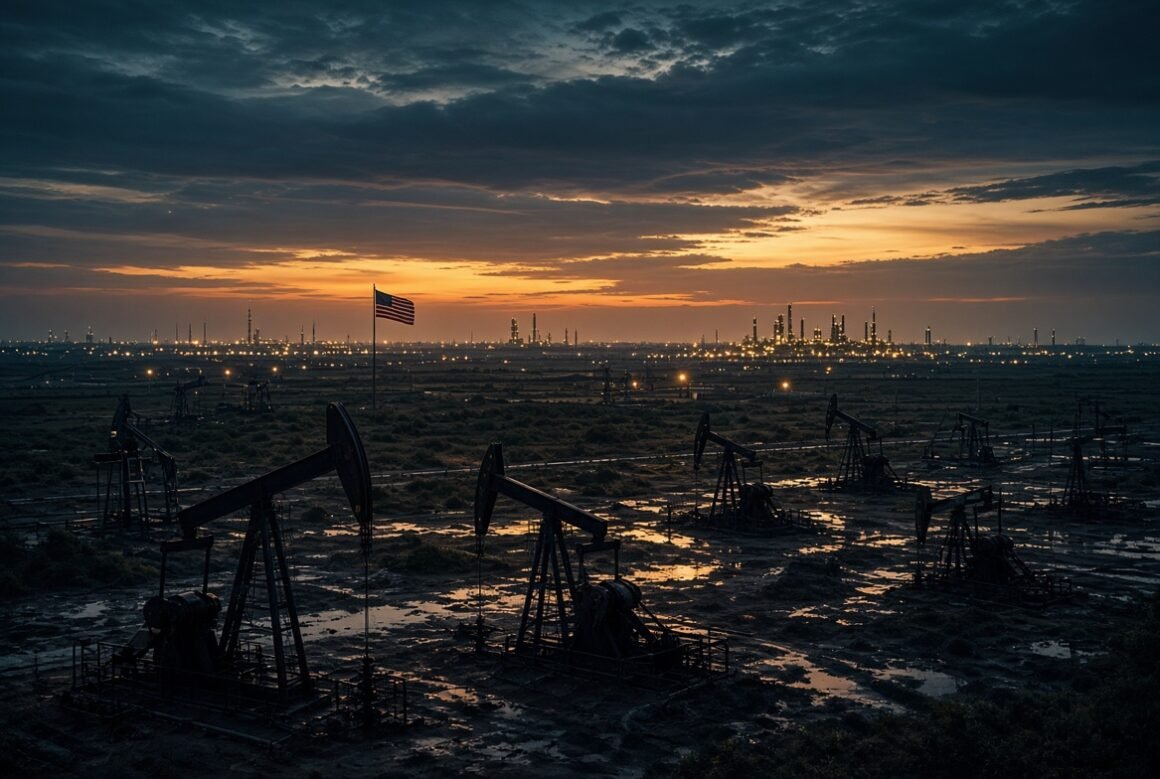
Venezuela Oil Deal: Why It Won’t Lower Gas Prices Next Week
President Trump called it the biggest oil deal in world history. The claim is simple enough for a campaign ad: the United States, working with private operators and Venezuela’s interim president Delcy Rodríguez, now has majority control of more than 65 billion barrels of proven reserves. He said it costs the American taxpayer nothing. He said it more than doubles American oil reserves. He said it will bring gas prices down.
What has actually been reported is narrower, slower, and more political than the headline.
This is not a cash purchase of crude sitting on a dock. Reporting describes a joint venture covering a cluster of 17 fields. The U.S. side would hold about a 55 percent effective stake — part ownership, part the right to buy crude at cost. Caracas says the package could pull in more than $100 billion of investment and more than $209 billion in taxes over time. One official described development rights measured in a century. No full contract text has been released. Until that document is public, every number in the announcement is a claim, not a receipt.
Context is not optional. American forces captured Nicolás Maduro earlier this year and brought him to the United States to face federal charges. Rodríguez is the leader Washington is now dealing with. Venezuela still sits on some of the largest proven reserves on earth — roughly a fifth of the world’s total, depending on the estimate — and produces a fraction of what it once did. The industry was looted, sanctioned, starved of capital, and run as a political machine for a generation. Heavy Venezuelan crude is also not a plug-and-play substitute for every barrel American refineries want. It needs specific kit, blending, and a security environment that does not collapse the week after the ribbon-cutting.
That is why the gas-price promise should be treated as a forecast, not a fact. Oil in the ground in the Orinoco Belt is not gasoline in Independence, Missouri. Fields have to be developed. Pipelines have to work. Ports have to load. Insurers have to underwrite the tankers. Markets can price future supply if investors believe the barrels will actually arrive. A social-media post cannot move the pump by itself. Anyone who has watched energy markets for more than one cycle has seen this movie: a political announcement, a spike in rhetoric, and then years of capital expenditure before a single incremental barrel shows up in a regular way.
“No cost to the taxpayer” is the other phrase that needs a second look. It may be true as a line-item appropriation. Direct Treasury outlay can be zero and the deal can still carry cost. Security in a country that just lost its previous president is a cost. Political legitimacy inside Venezuela is a cost. If the Pentagon’s Office of Strategic Capital is in the mix, public power is standing behind a private-looking structure. If barrels are earmarked for the Strategic Petroleum Reserve and the military, that is a national-security purchase wearing a consumer slogan. Americans should be able to support more Western Hemisphere supply without pretending the bill is imaginary.
There is a real case for the deal on energy grounds. More supply from a nearby source beats more dependence on a mined strait on the other side of the world. A wrecked industry that starts producing again is better for Venezuelans than a museum of rusted pumpjacks. Private capital going into fields the Venezuelan state could not run is closer to trade than to a lecture. Those points are serious. They are also not the same as “gas will be cheap next month” or “America just doubled its reserves in the way a family doubles a savings account.” Reserves on a slide deck are not production. Production is not refined product. Refined product is not the national average at the pump.
The right test is simple. A deal that expands supply without new taxes and without a permanent occupation is closer to commerce than to empire. A deal that requires an American security umbrella for a hundred-year joint venture is the other thing. The difference is in the contract, the force protection, and whether U.S. troops or U.S. guarantees become the silent partner. Until those terms are public, the victory lap is marketing.
Watch three things from here. One: does a signed agreement appear, with field lists, offtake rights, and a timeline that a petroleum engineer would recognize? Two: do private operators actually spend the first billions, or does the story stall at the press conference? Three: does any of this show up in inventories and crack spreads, or only in speeches? Energy policy that cannot survive those three questions is not policy. It is a poster.

Big John
I have an Associates & Bachelors Degree in Criminology with a minor in Political Science. I've been blogging since around 2017, my work has been viewed by 800,000 people, and I am a registered Libertarian. My work has been talked about on many of the largest news outlets in the world from Reuters, USA Today, Politifact, CheckYourFact.com, The Quint and many other outlets.


You May Also Like
Elon Musk Tells The World on ‘SNL’ He Has Asperger’s Syndrome

Catholics Cannot Become Free Masons According to Vatican