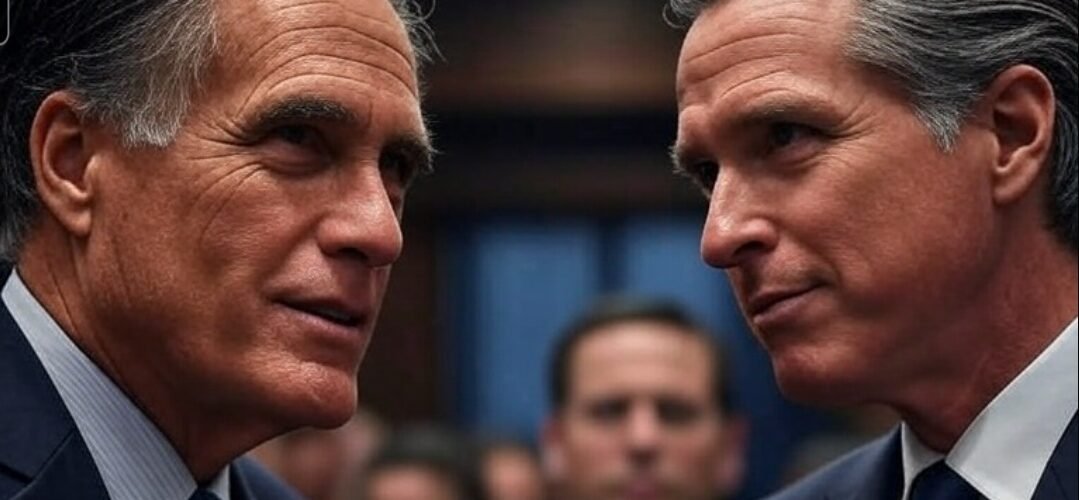
California Governor Gavin Newsom has increasingly drawn comparisons to Mitt Romney, the former Massachusetts governor and 2012 Republican presidential candidate, for his apparent willingness to shift political positions to suit the moment.
Like Romney, Newsom’s career is marked by a chameleon-like ability to adapt his rhetoric and policies to whatever seems politically expedient, raising questions about his sincerity and authenticity.
Critics argue that Newsom’s flip-flopping, coupled with his governance of California, has contributed to the state’s decline, while his two-faced persona and attacks on Donald Trump reveal a calculating politician whose ambitions for 2028 may lead to electoral disaster. Additionally, Newsom’s ambiguous stance on religion mirrors Romney’s Mormon faith, which some argue distances him from traditional Christian identity, further clouding his public persona.
Flip-Flopping: A Pattern of Political Inconsistency
Gavin Newsom’s political career is littered with examples of shifting stances, earning him the label of a “political chameleon.” Like Mitt Romney, who famously oscillated on issues like healthcare and abortion to appeal to different voter bases, Newsom has repeatedly changed positions to align with shifting political winds.
- Transgender Issues: Newsom positioned California as a “sanctuary” for transgender children, supporting policies allowing minors access to puberty blockers and hormone therapy. Yet, in March 2025, he shocked progressive allies by stating that biological males competing in women’s sports is “deeply unfair,” a stance that aligns more with conservative talking points. This abrupt shift was seen as an attempt to appeal to moderate voters as he eyes a 2028 presidential run, but it alienated parts of his progressive base.
- Gun Rights: Historically a strong advocate for gun control, Newsom surprised many by embracing gun ownership in a podcast appearance after the 2024 election, a move perceived as “bro-washing” to broaden his appeal to conservative-leaning voters. This pivot starkly contrasted with his earlier anti-gun rhetoric, which had been a cornerstone of his campaigns.
- Climate Change and Big Oil: Newsom has championed aggressive climate policies, including Net Zero goals, but in April 2025, he softened his stance when two oil companies threatened to close California refineries due to stringent regulations. His concessions to Big Oil were seen as a pragmatic retreat to avoid economic fallout, but they undermined his environmentalist credentials.
- Reparations and Racial Policies: Post-2020, Newsom embraced the racial reckoning following George Floyd’s death, pushing for reparations in California. However, as political tides shifted, he distanced himself from such progressive policies, adopting a more moderate tone to appeal to a broader electorate.
These shifts mirror Romney’s own history of flip-flopping, such as his support for a Massachusetts healthcare mandate (often likened to Obamacare) while later criticizing similar federal policies during his presidential run. Both men appear to adjust their positions based on political expediency, raising doubts about their core convictions. Critics, like former New York City Council Speaker Christine Quinn, have called Newsom “inauthentic” for these reversals, arguing that his changes lack sincerity and are driven by ambition.
Destroying California: A Record of Mismanagement
Newsom’s tenure as governor has been blamed for exacerbating California’s economic and social challenges, with critics arguing that his policies have contributed to a state of “neo-feudalism” marked by inequality, homelessness, and economic stagnation. Here are key examples of how his governance has hurt California:
- Homelessness Crisis: California accounts for nearly half of the nation’s homeless population, with over 187,000 individuals living on the streets. Newsom’s initiatives, such as increased funding for affordable housing and mental health services, have been criticized as insufficient and poorly executed. Critics argue he prioritizes optics, like clearing homeless encampments, over addressing root causes like housing costs and mental health access.
- Economic Decline: California has the highest cost-of-living-adjusted poverty rate and unemployment rate (5.5%) in the U.S. Under Newsom, the state has lost 1.6 million above-average-paying jobs over the past decade, creating five times as many low-wage jobs as high-wage ones. This shift has eroded the middle class, turning California into a state of stark inequality.
- High-Profile Scandals: Newsom’s credibility has been tarnished by personal and administrative missteps. His attendance at a lavish dinner at the French Laundry during COVID-19 lockdowns, while urging Californians to stay home, sparked widespread outrage and fueled a recall effort. Additionally, scandals like a $1.7 million public toilet project and a questionable $1 billion mask deal have painted him as out of touch and wasteful.
- Crime and Public Safety: Critics point to rising crime rates and Newsom’s perceived leniency on criminal justice reforms as contributing to public safety concerns. California’s high gas prices and cost of living further strain residents, with Newsom’s policies failing to alleviate these burdens.
These issues have led commentators like Joel Kotkin to argue that Newsom has overseen California’s transformation from a land of opportunity to a state of entrenched inequality, where only the ultra-wealthy thrive. His focus on national ambitions, critics say, has distracted him from addressing these pressing state-level problems.
Two-Faced Persona: Smiling While Scheming
Newsom’s public demeanor—polished, charismatic, and often conciliatory—belies a reputation for political ruthlessness. Critics describe him as a master manipulator who projects warmth while pursuing calculated moves for personal gain. This duality is evident in several instances:
- French Laundry Hypocrisy: Newsom’s public apology for attending the French Laundry dinner contrasted sharply with his private dismissal of the controversy, revealing a disconnect between his public contrition and private indifference.
- Personal Scandals: In 2007, Newsom admitted to an affair with his campaign manager’s wife while mayor of San Francisco, issuing a public apology but continuing his political ascent. This incident, coupled with his polished family-man image, has led critics to question his sincerity.
- Political Maneuvering: Newsom’s recent push to redraw California’s congressional districts to favor Democrats, while decrying Republican gerrymandering in Texas, showcases his willingness to bend principles for political advantage. Critics argue this move, framed as a defense of democracy, is a cynical ploy to bolster his national profile.
This two-faced nature draws parallels to Romney, whose affable demeanor masked a willingness to shift positions to win votes, earning him distrust among both conservatives and moderates. Newsom’s ability to “smile in your face and stab you in the back” is seen by detractors as the hallmark of a career politician who prioritizes power over principle.
Religious Ambiguity: Mirroring Romney’s Mormon Question
Mitt Romney’s Mormon faith was a point of contention during his political career, with some questioning whether Mormons are “true Christians” due to theological differences, such as the Church of Jesus Christ of Latter-day Saints’ distinct doctrines.
Similarly, Gavin Newsom’s religious beliefs are shrouded in ambiguity, with no clear public statement on whether he identifies as Christian or holds any faith at all. This lack of clarity draws a parallel to Romney’s experience, as both men face scrutiny over their spiritual identities in a country where religious affiliation often shapes voter perceptions.
Newsom, a lifelong Catholic by upbringing, has rarely discussed his personal faith, focusing instead on secular progressive values. His policies, such as supporting abortion rights and transgender protections, have put him at odds with traditional Catholic teachings, leading some to speculate that his faith is either nominal or politically inconvenient.
Unlike Romney, who openly embraced his Mormon identity despite criticism, Newsom’s reticence about religion leaves voters guessing. This ambiguity could alienate religious voters in a national election, much as Romney’s Mormonism raised questions among evangelical Christians. While Romney’s faith was explicit but divisive, Newsom’s undefined stance creates a different kind of skepticism, suggesting a lack of conviction that aligns with his broader pattern of inauthenticity.
2028 Election Strategy: A Recipe for Disaster
Newsom’s aggressive anti-Trump strategy, characterized by Trump-style all-caps social media posts and public attacks, is seen by some as a bid to energize the Democratic base for a 2028 presidential run. However, this approach is fraught with risks and could lead to a catastrophic electoral loss:
- Trump Obsession: Newsom’s focus on Trump, who will not be president in 2028 or 2032 due to term limits, seems misdirected. His trolling—such as mocking Trump’s immigration policies or physical stamina—may resonate with progressives but risks alienating moderates who seek forward-looking leadership. Moreover, Newsom’s failure to raise these criticisms during reported meetings with Trump undermines his credibility, portraying him as opportunistic rather than principled.
- California’s Baggage: Newsom’s record in California, marked by economic woes, homelessness, and scandals, is a liability on the national stage. Voters outside the state may view him as a symbol of liberal excess, much as Romney’s Massachusetts healthcare plan was weaponized against him. Billionaire Democratic donor John Morgan has called Newsom a “grandstanding phony,” reflecting skepticism even within his party.
- Inauthenticity Concerns: Newsom’s flip-flopping and trolling tactics, while attention-grabbing, risk portraying him as a caricature of a politician. His imitation of Trump’s style has been criticized as “cringe” and inauthentic, potentially turning off voters seeking genuine leadership.
- Redistricting Gamble: Newsom’s push for a special election to redraw California’s congressional maps is a high-stakes move. A loss in this heavily Democratic state could cripple his national ambitions, while even a win may deepen perceptions of partisan manipulation.
Like Romney, whose 2012 campaign struggled to overcome perceptions of elitism and inauthenticity, Newsom risks being seen as a slick, opportunistic politician whose California record and shifting stances undermine his electability. His strategy of “fighting fire with fire” against Trump may energize some Democrats but could alienate the broader electorate needed to win a national election.
Hypocrisy and Contradictions: The Podcast Facade
Newsom’s podcast appearances, where he has welcomed conservative figures like Steve Bannon, present him as open to dialogue and bipartisanship. Yet, his public attacks on Trump and MAGA supporters starkly contrast with this image.
Critics argue that Newsom’s willingness to engage conservatives privately while vilifying them publicly reveals his hypocrisy. For instance, his claim that Trump’s actions are a “brazen abuse of power” regarding immigration enforcement was never raised during their meetings, suggesting he tailors his rhetoric to different audiences for maximum political gain. This mirrors the criticism Romney faced for appearing moderate in Massachusetts but pivoting to conservative talking points during his presidential campaign.
On his podcast, Newsom projects a thoughtful, inclusive persona, but his social media antics—such as AI-generated memes and all-caps rants—undercut this image, portraying him as a provocateur willing to stoop to any level for attention. This duality reinforces the perception that Newsom is a “piece of shit human” whose only loyalty is to his political ambitions, willing to betray allies or principles to climb the ladder.
A Crook and Master Politician
Gavin Newsom embodies the archetype of a master politician—charismatic, adaptable, and ruthless—but his flip-flopping, mismanagement of California, and hypocritical attacks on Trump paint him as a deeply flawed figure. Like Mitt Romney, Newsom’s shape-shifting persona risks alienating voters who crave authenticity. His ambiguous religious stance, mirroring Romney’s Mormon-related challenges, adds another layer of distrust.
As he positions himself for 2028, Newsom’s strategy of trolling Trump and chasing national attention may backfire, setting the stage for a potential electoral disaster. California’s struggles under his watch, combined with his two-faced tactics, suggest that Newsom is less a visionary leader and more a calculating opportunist—the epitome of a politician whose ambition overshadows integrity.